
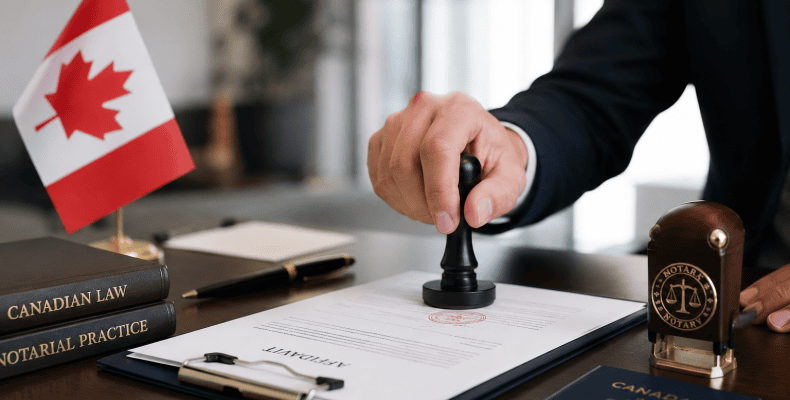
If you are preparing documents for use outside your home country, chances are you have already come across the term notarized affidavits for Canada. Whether you are applying for a study permit, settling an estate, registering a marriage, or completing a business transaction, Canadian institutions and foreign governments alike often require sworn statements that carry the signature and seal of a licensed notary. This guide walks you through everything you need to know about notarized affidavits for Canada, drawing on the official steps published by Global Affairs Canada, so you can prepare your paperwork with confidence and avoid costly delays.
Understanding notarized affidavits for Canada is not just a bureaucratic formality. It is a legal safeguard that protects everyone involved. When a notary signs and seals a sworn statement, they are confirming that the person making the declaration appeared before them, provided proof of identity, and understood the contents of the document. This process gives notarized affidavits for Canada the credibility that courts, immigration officers, financial institutions, and foreign authorities rely on when deciding whether to accept a document as genuine.
What Is an Affidavit and Why Does It Need Notarization
An affidavit is a written statement of facts that a person swears or affirms to be true, usually in front of a notary public or a commissioner of oaths. Once notarized, the document becomes notarized affidavits for Canada that can be submitted to government offices, embassies, universities, or private companies as proof of a claim. Common examples include affidavits of single status, affidavits confirming identity, affidavits supporting an immigration application, and affidavits used in estate or property matters.
Notarization adds a layer of trust to these declarations. Without the notary seal and signature, many organizations simply will not accept the document, particularly when it will be used internationally. This is why so many individuals and businesses search for reliable providers of notarized affidavits for Canada rather than attempting to navigate the process alone.
Does My Document Need To Be Notarized
Before you request notarized affidavits for Canada, it helps to confirm whether your specific document actually requires notarization. According to Global Affairs Canada, you should first find out if your document needs to be notarized before it can be authenticated by their office. Some documents, such as certain government issued certificates, may not need notarization at all, while others absolutely require it before they can move forward in the authentication chain.
If your original document cannot be authenticated on its own, a notarized copy may be accepted instead. However, not every country accepts notarized copies for every category of document. Before you invest time and money into notarized affidavits for Canada, confirm with the destination country whether a notarized copy will be sufficient or whether the original document is mandatory. This single step can save you from having to repeat the entire process later.
Who Can Notarize My Document
One of the most common questions we hear at PAC Signing is who is actually allowed to prepare notarized affidavits for Canada. The answer is straightforward. Any Canadian notary whose signature is recognized by Global Affairs Canada can notarize your document. That said, the province where the notarization takes place can affect where you ultimately submit your paperwork, since different provinces are designated as competent authorities for authentication purposes.
This means that when you choose a notary for notarized affidavits for Canada, it is worth confirming that their appointment and province align with the requirements of the office that will later authenticate your documents. A qualified notary will be familiar with these regional rules and can advise you accordingly.
How Do I Find A Canadian Notary
Finding a professional to prepare notarized affidavits for Canada does not have to be complicated. A simple search for notary public services in your area is usually the starting point. Because the rules governing Canadian notaries vary between provinces and territories, the notary you choose will explain exactly what they are able to do for your particular situation.
At PAC Signing, our team specializes in notarized affidavits for Canada and related documents, guiding clients through every requirement so nothing gets overlooked. We work with individuals, families, and businesses who need dependable, accurate notarization completed the first time.

How Is My Document Notarized
Understanding the mechanics behind notarized affidavits for Canada helps you know what to expect during your appointment. A Canadian notary signs and seals your document, and in many cases also prepares a separate certificate that is signed and attached to the original paperwork.
When completing notarized affidavits for Canada, the notary must follow several important requirements. First, they must hold a valid certificate of appointment issued by the appropriate governing body. Second, they must handwrite their signature in ink rather than relying on a stamp or digital mark. Third, they must apply a physical stamp or seal that clearly shows their full legal name exactly as it appears on their certificate of appointment, along with the Canadian province or territory where they were appointed.
In addition, the notary must indicate the specific act they performed, such as certifying a true copy or witnessing a signature. They must also record the date on which they performed that act, and if applicable, the date on which their appointment as a notary expires. All of these elements combine to give notarized affidavits for Canada their legal weight and make them acceptable to receiving institutions both inside and outside the country.
Skipping any one of these steps can result in a rejected document, forcing you to start the entire process again. This is precisely why so many people trust a dedicated notary service rather than attempting to interpret the requirements themselves.
What Can My Notary Actually Do
When you request notarized affidavits for Canada, your notary can perform several distinct functions depending on your needs. They can witness a signature, confirming that you personally signed the document in their presence. They can receive a declaration or affidavit, listening to your sworn statement and formally recording that you made it. They can also certify that a document is a true copy of an original, which is especially useful when submitting supporting paperwork alongside your affidavit.
Each of these services plays a different role in the broader authentication process, so it is important to tell your notary exactly what you need before your appointment. Bringing the wrong type of request could mean your notarized affidavits for Canada do not satisfy the requirements of the office or organization requesting them.
Translated Documents and Notarized Affidavits for Canada
If your affidavit or supporting paperwork is not in English or French, you may also need a certified translation. A Canadian notary who speaks both the source language and the target language may be able to certify that translation as accurate. When this applies to your notarized affidavits for Canada, make sure the notary clearly states on the document that they attest to speaking both languages and that they certify the accuracy of the translation itself.
This detail matters more than many people realize. Immigration offices, courts, and foreign embassies frequently reject translated documents that lack this specific language attestation, even when the translation itself is accurate. A knowledgeable notary will know exactly how to phrase this certification so your notarized affidavits for Canada are accepted the first time.
Common Types of Affidavits People Request
Over the years, our team at PAC Signing has prepared notarized affidavits for Canada covering a wide range of personal, legal, and business situations. Some of the most frequent requests include affidavits of single status for marriage abroad, affidavits confirming a change of name, affidavits supporting sponsorship applications, affidavits of financial support for students, affidavits used in probate and estate settlement, and affidavits confirming residency or identity for banking purposes.
Business clients also rely on this type of sworn documentation when confirming company ownership, verifying signing authority, or supporting international contracts. Regardless of the purpose, the underlying process remains consistent: a sworn statement, verified identity, and a properly executed notary seal and signature.
Five Steps to Getting Your Affidavit Notarized
Step one is determining whether your document actually requires notarization. As mentioned earlier, not every document does, so confirm this before booking an appointment for notarized affidavits for Canada.
Step two is preparing your document in advance. Have a draft of the affidavit ready, along with valid government issued photo identification. The notary will need to confirm your identity before witnessing your signature or receiving your declaration.
Step three is choosing a licensed Canadian notary whose appointment is recognized for the province where you need your notarized affidavits for Canada prepared. This choice matters because the province of notarization can influence where your document is later submitted for authentication.
Step four is attending your appointment and signing in the presence of the notary. Do not sign the affidavit beforehand, since the notary must personally witness the act of signing for the notarization to be valid.
Step five is reviewing the completed document. Confirm that the notary has handwritten their signature, applied their official stamp or seal showing their full name and province of appointment, indicated the act performed, and recorded the relevant dates. A complete review at this stage prevents delays later in the authentication process for your notarized affidavits for Canada.
After Notarization: What Comes Next
Once you have obtained this notarized documentation, many applicants still need to complete authentication, and in some cases legalization, before the document is accepted abroad. Authentication confirms that the notary who signed your document is indeed recognized and in good standing. Depending on the destination country, an additional step called legalization may also be required at that country’s embassy or consulate.
Not every document needs this extra layer, so it is worth checking the specific requirements of the country where your notarized affidavits for Canada will be used. Missing this step is one of the most common reasons documents are returned or rejected, so plan for it early rather than discovering the requirement after your notary appointment.
Why Accuracy Matters So Much
A single missing detail, such as an expired certificate of appointment or an incomplete seal, can invalidate notarized affidavits for Canada entirely. Institutions reviewing these documents are trained to spot inconsistencies, and even a small error can send your paperwork back for correction. This is frustrating for anyone on a deadline, whether you are finalizing an immigration application, closing on a property, or submitting documents for a court proceeding.
Working with an experienced provider reduces this risk considerably. At PAC Signing, every notarized affidavit is reviewed against the current requirements before it leaves our office, so clients can move forward with confidence rather than worrying about rejection.
Common Mistakes to Avoid
Many people make avoidable errors when arranging notarized affidavits for Canada. One frequent mistake is signing the document before arriving at the appointment, which invalidates the notarization since the notary must witness the signature directly. Another mistake is bringing outdated or invalid identification, which prevents the notary from confirming who you are. A third mistake is assuming that a notarized copy will always be accepted, when in fact some countries require the original document instead.
People also sometimes forget to ask about translation certification when their affidavit is not in English or French, or they overlook the additional authentication and legalization steps required after notarization. Avoiding these mistakes from the start saves significant time and stress when preparing notarized affidavits for Canada for an important deadline.
How PAC Signing Can Help
At PAC Signing, we understand how stressful it can be to prepare notarized affidavits for Canada, especially when a deadline is approaching or the requirements feel unclear. Our experienced team guides you through every stage, from confirming whether notarization is required, to preparing the affidavit itself, to reviewing the final document for accuracy before you submit it for authentication.
We work with individuals relocating internationally, families managing estates, students applying to study abroad, and businesses handling cross border transactions. Because we prepare notarized affidavits for Canada on a daily basis, we know exactly what receiving institutions expect and how to avoid the small errors that lead to rejected paperwork.
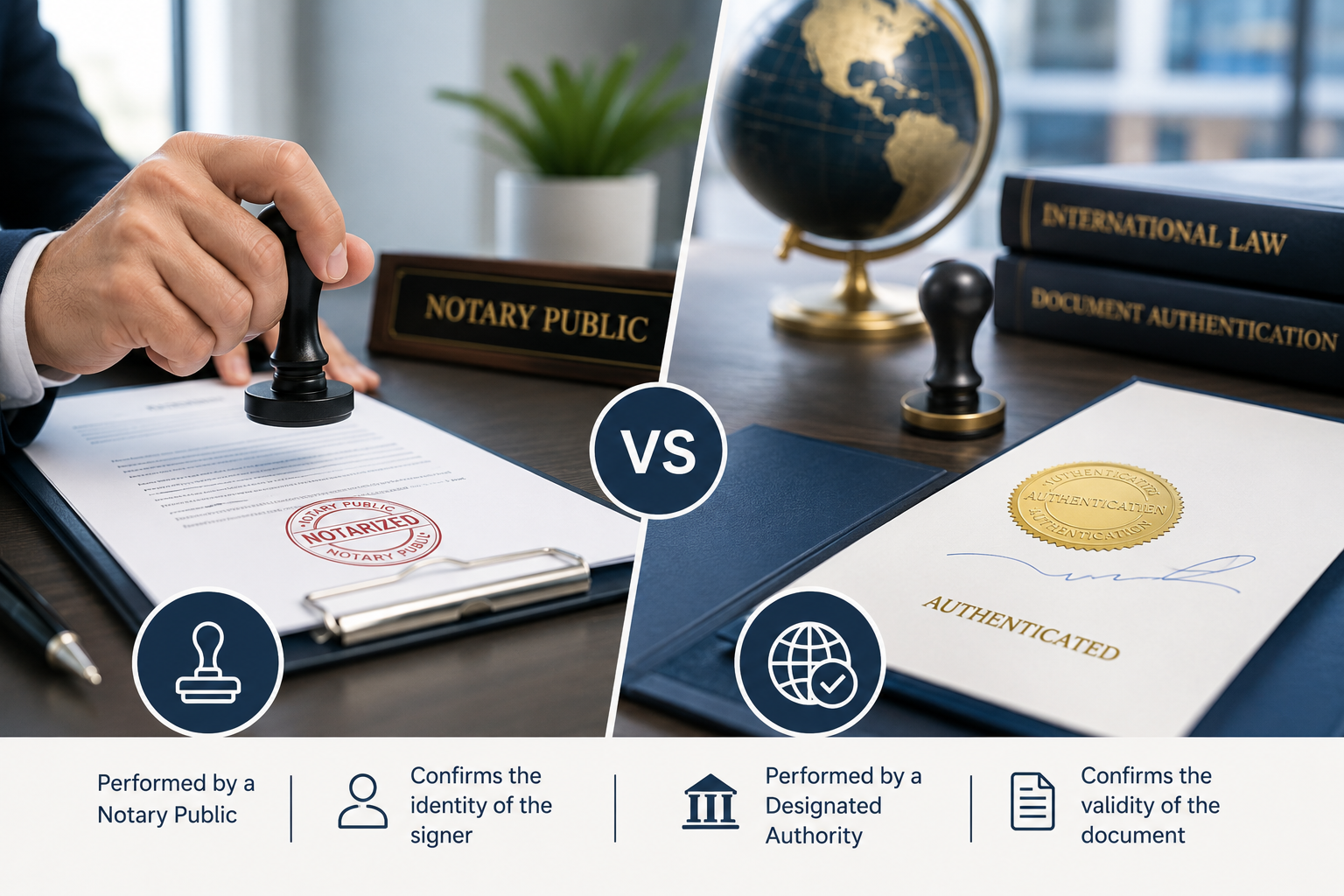
The Difference Between Notarization and Authentication
Many clients confuse notarization with authentication, yet the two steps serve different purposes in the overall process. Notarization is the first stage, where a licensed notary confirms your identity, witnesses your signature, or certifies a copy as true. Notarized affidavits for Canada are the product of this first stage. Authentication is a separate step performed by a government office, which confirms that the notary who signed your document is genuinely recognized and holds a valid appointment.
Some destination countries require an additional third stage called legalization, completed at their embassy or consulate, before the document can be used for its intended purpose. Understanding this sequence helps you plan realistic timelines. If you assume that notarized affidavits for Canada are automatically ready for use abroad the moment they leave the notary office, you may be caught off guard when a foreign institution asks for proof of authentication as well. Building extra time into your schedule for these additional steps prevents last minute stress, particularly if you are working toward a firm deadline such as a court date, a school application, or a property closing.
Cost, Timeline, and What to Expect at Your Appointment
The cost of preparing notarized affidavits for Canada varies depending on the complexity of the document, the number of signatures required, and whether translation certification is also needed. A simple single page affidavit typically takes less time than a multi page document with several supporting attachments. Most notary appointments themselves are relatively short, often lasting between fifteen and thirty minutes, provided you arrive prepared with your identification and a draft of the affidavit ready for review.
It helps to book your appointment in advance rather than assuming a notary will be available on short notice, especially during busy periods such as the start of an academic term or peak immigration application season. When you contact PAC Signing to arrange notarized affidavits for Canada, our team will walk you through what to bring, how long the process should take, and whether any additional certification or translation services apply to your specific situation. Being prepared in advance is one of the simplest ways to keep this documentation on schedule and avoid unnecessary delays.
Documents Often Paired With Notarized Affidavits
In many cases, an affidavit does not stand alone. Supporting documents such as identification, proof of address, financial statements, or original certificates often accompany notarized affidavits for Canada when they are submitted to an embassy, school, or government office. The notary may be asked to certify some of these supporting documents as true copies of the original, which is one of the specific functions a notary is permitted to perform.
Before your appointment, it is worth making a checklist of every document your receiving institution has requested, since missing even one supporting item can delay approval. A reputable notary service will help confirm this checklist with you, ensuring that everything submitted alongside your notarized affidavits for Canada meets the expectations of the office reviewing your file.
Frequently Asked Questions
Do all documents need to be notarized before authentication?
No, some documents can be authenticated without notarization, so it is important to check the specific requirements for your document type before booking an appointment.
Can any lawyer notarize my affidavit? Not necessarily.
What matters is whether the person has a valid appointment as a notary and whether their signature is recognized for authentication purposes.
Does the province where I get notarized affidavits for Canada matter?
Yes, the province of notarization can affect where you later submit your documents for authentication, so confirm this detail before your appointment.
What identification do I need to bring?
Valid government issued photo identification is required so the notary can confirm your identity before witnessing your signature or receiving your declaration.
How long does the notarization process take?
A standard appointment for notarized affidavits for Canada is usually brief, though preparation time beforehand, such as drafting the affidavit and gathering identification, should not be rushed.
Serving Clients Across the Country
Whether you live in a major city or a smaller community, the requirements for notarized affidavits for Canada remain largely consistent, though the exact submission office can differ slightly by province. Some clients need paperwork completed quickly ahead of a travel date, while others are working through a longer estate or immigration process. A dependable notary service should accommodate both situations, offering clear communication so you always know what stage your documents are at.
Remote appointments have also become more common in recent years, allowing some clients to complete portions of the process without visiting an office in person. Regardless of how you connect with your notary, the fundamentals stay the same: verified identity, a properly witnessed signature, and an accurate seal.
Final Thoughts
Preparing notarized affidavits for Canada does not need to be overwhelming when you understand the process and work with a qualified notary. From confirming whether your document requires notarization, to choosing a notary recognized in the correct province, to reviewing every detail on the finished document, each step plays a meaningful role in whether your paperwork will be accepted where it is needed.
If you are ready to move forward, PAC Signing is here to help with reliable notarized affidavits for Canada prepared accurately and efficiently. Reach out to our team today to schedule your appointment and take the uncertainty out of the notarization process.