
If you are trying to notarize documents for South Korea, you already know the process can feel confusing. Between apostilles, embassy rules, and translation requirements, many people do not know where to begin. This guide walks you through every step so you can notarize documents for South Korea correctly the first time.
At PAC Signing, we work with individuals, families, and businesses who need to notarize documents for South Korea for reasons ranging from marriage registration to corporate filings. Whether you are sending a power of attorney, a diploma, a business license, or an adoption record, the steps below will help you understand exactly what is required.
Why You May Need to Notarize Documents for South Korea
There are many personal and professional reasons people need to notarize documents for South Korea. Some of the most common situations include marriage or divorce registration with Korean authorities, adoption proceedings, university admissions or degree verification, employment visa applications, opening a bank account, registering a business, real estate transactions, and litigation or court filings.
Each of these situations involves official paperwork that Korean government agencies, banks, universities, or courts will only accept once it has been properly certified. That is where the process to notarize documents for South Korea becomes essential. Without proper certification, your documents may be rejected outright, causing delays that can cost you time, money, and peace of mind.
Understanding South Korea and the Hague Apostille Convention
South Korea has been a member of the Hague Apostille Convention since July 2007. This membership matters greatly to anyone who needs to notarize documents for South Korea, because it means that documents issued in another member country, such as the United States, can be certified with a single apostille rather than going through a lengthy chain of embassy authentications.
Before the country joined the convention, people who wanted to notarize documents for South Korea had to complete a much longer legalization process involving multiple government offices and consular authentication. Today, thanks to the apostille system, the process is far more streamlined for documents moving between member countries.
It is important to note that an apostille only confirms the origin of a public document. It verifies the signature, the capacity in which the signer acted, and the seal or stamp attached to the document. It does not comment on the content of the document itself. This distinction matters when you notarize documents for South Korea, since the notarization and the apostille serve two separate but connected purposes.
The Difference Between Notarization and an Apostille
Many clients ask us to explain the difference before they notarize documents for South Korea. Notarization is the act of a licensed notary public witnessing a signature, administering an oath, or certifying that a copy of a document is true and accurate. An apostille, on the other hand, is a certificate that authenticates the notary public seal itself, confirming that the notary who performed the notarization is properly registered and licensed.
In other words, notarization happens first, and the apostille comes after. During this process, the notary public signs and stamps the document, and then a designated government authority issues the apostille that validates the notary signature. Korean authorities generally require both steps to accept a foreign document as legitimate.
Which Authorities Issue an Apostille for Documents Bound for Korea
If your documents originate in the United States, the apostille is typically issued by the Secretary of State in the state where the document was notarized or the state where the public record was issued. Federal documents may require an apostille from the United States Department of State instead.
Once your documents arrive in South Korea, or if they are Korean documents themselves, the apostille is issued by one of two government bodies. The Ministry of Justice handles apostilles for documents related to judicial and notarial matters, while the Ministry of Foreign Affairs issues apostilles for many public and administrative documents. Knowing which authority applies to your paperwork is a key part of learning how to notarize documents for South Korea without unnecessary delays.
What an Apostille Certificate Looks Like
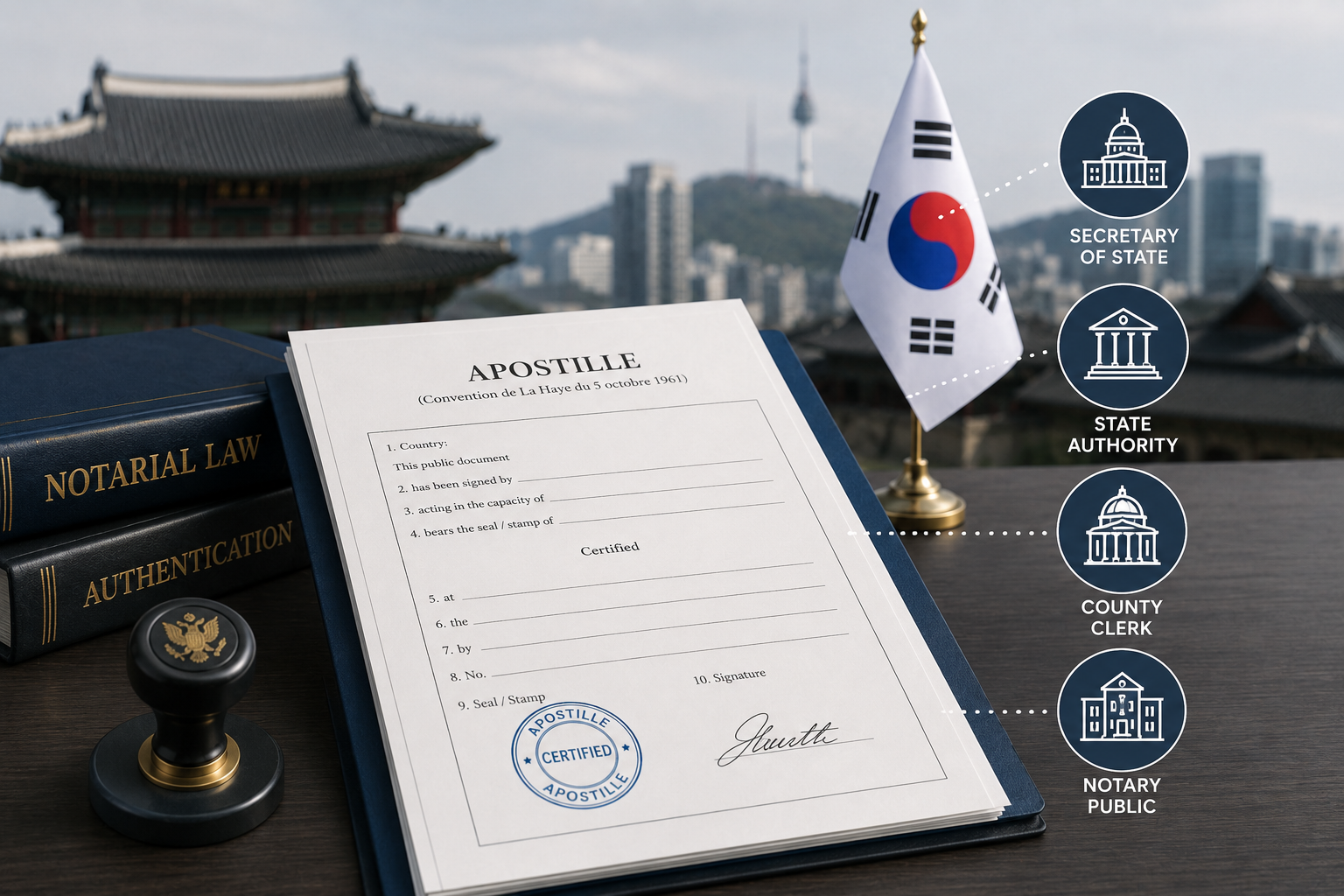
When you notarize documents for South Korea and later obtain an apostille, the certificate itself follows a standardized format recognized by all member countries of the Hague Convention. It typically contains ten numbered fields, including the country of issue, the name of the signer, the capacity of the signer, the name of the authority or office whose seal appears on the document, the place and date of issue, the issuing authority, a certificate number, and the seal and signature of the official who issued the apostille.
The heading on the certificate appears in French, since French was the official language of the original 1961 convention. This is standard across every apostille worldwide, so do not be alarmed if the certificate you receive includes French text at the top of the page.
Types of Documents That Commonly Need Notarization for Korea
People notarize documents for South Korea for a wide variety of purposes. Personal documents often include birth certificates, marriage certificates, divorce decrees, powers of attorney, affidavits, diplomas and academic transcripts, criminal background checks, and adoption paperwork.
Business documents that frequently require notarization and apostille include articles of incorporation, certificates of good standing, business licenses, board resolutions, powers of attorney for corporate representatives, commercial invoices, and certificates of free sale for products entering the Korean market.
Because Korean government offices, banks, universities, and courts are strict about accepting only properly certified paperwork, it is wise to confirm exactly which documents you need to notarize documents for South Korea before you begin the process. Contacting the receiving institution in Korea ahead of time can save you from resubmitting paperwork later.
Step by Step Process to Notarize Documents for South Korea
The first step to notarize documents for South Korea is identifying exactly what type of certification your receiving institution requires. Some organizations accept a simple notarized copy, while others require a full apostille, and some require both notarization and translation.
The second step is locating a licensed notary public who can properly witness signatures or certify copies. A commissioned notary signing agent, like the professionals at PAC Signing, can travel to your location, verify your identity, and complete the notarization correctly so there are no issues later during the submission stage.
The third step is obtaining the apostille from the appropriate authority. In the United States, this generally means submitting the notarized document to your state Secretary of State office, along with any required fees and processing forms. Processing times vary by state, so it helps to plan ahead if you are on a deadline.
The fourth step, which many people overlook, is translation. If your documents are not already in Korean, the receiving agency may require a certified translation. Some agencies also require that the translation itself be notarized before you can fully notarize documents for South Korea and submit your paperwork.
The fifth and final step is submission. Once your documents are notarized, apostilled, and translated if necessary, you can submit them to the relevant Korean embassy, consulate, or government office, or forward them directly to the requesting institution in Korea.
Working With a Professional Notary Signing Agent
One of the easiest ways to notarize documents for South Korea without mistakes is to work with an experienced notary signing agent. At PAC Signing, our team understands the nuances involved when documents are destined for international use. We know which documents typically require an apostille, how to properly complete acknowledgments and jurats, and how to avoid common errors that cause Korean authorities to reject paperwork.
When you choose our team for this process, we verify your identification, confirm the document type, and ensure every signature and notarial certificate meets the standards required for apostille processing. This attention to detail reduces the risk of your documents being sent back, which can add weeks to an already time sensitive process.
Common Mistakes People Make When They Notarize Documents for South Korea
Many delays happen because people try to notarize documents for South Korea without fully understanding the requirements. One common mistake is assuming that a simple notarization is enough when the receiving agency actually requires a full apostille. Another mistake is failing to check whether a certified translation is needed before submission.
Some people also sign a document before meeting with the notary, which invalidates the notarization since the notary must witness the signature in person or through approved remote means. Others use an expired identification document, which prevents the notary from verifying identity and completing the notarization.
Timing is another frequent issue. Apostille processing can take anywhere from a few days to several weeks depending on the state or authority involved, so waiting until the last minute to notarize documents for South Korea can create serious problems for time sensitive matters like visa applications or court deadlines.
How Long Does It Take to Notarize Documents for South Korea
The overall timeline for this process depends on several factors, including how quickly you can meet with a notary, how long the apostille authority takes to process your request, and whether translation is required. A straightforward notarization can often be completed the same day, especially if you work with a mobile notary signing agent who can meet you at your home or office.
The apostille step usually takes longer, ranging from a few business days to a few weeks depending on the issuing authority and whether expedited service is available. If your documents also need certified translation into Korean, add additional time for that step as well. Planning several weeks ahead is a wise approach for anyone who needs to notarize documents for South Korea for an important deadline.
Tips for a Smooth Experience
To make the process to notarize documents for South Korea as smooth as possible, gather all original documents before your notary appointment, confirm the exact requirements with the receiving institution in Korea, bring valid government issued photo identification, and ask your notary signing agent about apostille and translation services in advance.
It also helps to keep copies of every document at each stage of the process, from the original, to the notarized version, to the apostilled version, and finally the translated version if applicable. This way, if any institution asks for additional copies, you will have them ready without needing to repeat the entire process.
Why Choose PAC Signing to Notarize Documents for South Korea
At PAC Signing, we specialize in helping individuals, families, and businesses notarize documents for South Korea with accuracy and care. Our commissioned notary signing agents are experienced with international document requirements, and we understand how important it is to get every detail right the first time.
We offer flexible scheduling, including evening and weekend appointments, so you can notarize documents for South Korea without disrupting your work or family obligations. Our team can also guide you toward reputable apostille and translation resources so your entire document package is ready for submission.
Whether you need a single power of attorney notarized or a full set of corporate documents prepared for a Korean business filing, PAC Signing is ready to help you notarize documents for South Korea correctly, efficiently, and professionally.
Working With Korean Consulates and Embassies in the United States
Some people mistakenly believe that a Korean consulate or embassy will handle every step needed to notarize documents for South Korea. In reality, the consulate role is usually limited to specific administrative functions, such as issuing certain civil documents, verifying identity for particular applications, or accepting completed and apostilled paperwork for forwarding to Korean authorities.
Because South Korea is a member country of the Hague Apostille Convention, documents that already carry a valid apostille generally do not need additional consular authentication. This is a significant advantage compared to countries that are not part of the convention, where a lengthy chain of consular legalization is still required. Understanding this distinction can save considerable time when you notarize documents for South Korea and prepare them for submission.
That said, it is always wise to check with the specific Korean consulate nearest you, since requirements can vary slightly depending on the type of document and the purpose of the submission. Calling ahead or reviewing the consulate website before your appointment can prevent unnecessary trips and help you complete this process with confidence.
Documents for Business Expansion Into the Korean Market
Companies expanding into South Korea often need to notarize documents for South Korea as part of establishing a local branch, subsidiary, or liaison office. This typically includes notarized and apostilled copies of articles of incorporation, certificates of good standing, board resolutions authorizing the expansion, and powers of attorney appointing a local representative.
Financial institutions and government registries in Korea are particularly strict about verifying that corporate documents are authentic before allowing a foreign company to register or open a bank account. Any missing certification, incorrect notarial wording, or expired document can delay a business launch by weeks. For this reason, many companies choose to work with a professional notary signing agent from the very beginning of the process to notarize documents for South Korea, rather than attempting the paperwork on their own and risking costly mistakes.
Trademark applications, licensing agreements, and distribution contracts destined for Korean partners may also require notarization and apostille certification. Reviewing every document carefully with legal counsel and a notary signing agent before submission helps ensure a smoother business registration experience.
International Shipping and Delivery Considerations
Once you notarize documents for South Korea and obtain the necessary apostille, you still need to consider how the physical documents will reach their destination. Many government agencies and universities in Korea require original, wet ink documents rather than scanned copies, which means shipping plays an important role in the overall timeline.
Choosing a reliable courier service with tracking and signature confirmation helps protect valuable original paperwork during transit. Some clients prefer to send documents in batches to reduce shipping costs, while others send urgent paperwork separately to meet strict deadlines. Building shipping time into your overall plan is an easy way to avoid last minute stress when you handle paperwork for a time sensitive matter such as a visa interview or university enrollment deadline.
It is also worth keeping digital scans of every notarized and apostilled document before mailing the originals. While most Korean institutions require physical paperwork, having digital backups allows you to quickly respond to any questions or provide additional copies if something is lost in transit.
Understanding Fees and What Influences Cost
The total cost to notarize documents for South Korea depends on several moving parts. Notary signing agent fees typically depend on the number of signatures, travel distance, and appointment timing, with evening or weekend appointments sometimes carrying a small additional charge. Apostille fees are set by the issuing state or federal authority and can vary widely depending on how many documents are submitted at once and whether expedited processing is requested.
Translation costs depend on the length and complexity of the document, as well as whether the translation itself needs to be notarized. Shipping fees for sending original documents to Korea should also be factored into your overall budget. Requesting a full quote that includes every stage of the process, rather than just the notarization fee, helps avoid unexpected costs when you prepare paperwork for use abroad.
Comparing quotes from a few providers is a reasonable way to gauge fair market pricing, but the lowest price is not always the best choice. An experienced notary signing agent who understands international requirements can prevent costly mistakes, such as an improperly worded notarial certificate that gets rejected by the apostille authority, which ends up costing far more time and money in the long run than a slightly higher upfront fee would have cost.
Frequently Asked Questions
Do all documents need an apostille to be accepted in South Korea?
Not every document requires a full apostille. Some institutions accept a simple notarized copy, while others insist on apostille certification. Always confirm with the receiving institution before you notarize documents for South Korea.
Can I notarize documents for South Korea if I live outside the United States?
Yes, notarization and apostille requirements exist in nearly every country that participates in the Hague Convention, so this process is possible from almost anywhere. The specific authority that issues the apostille will depend on where your documents originate.
How much does it cost to notarize documents for South Korea?
Costs vary depending on the number of documents, the notary signing agent fees, apostille processing fees, and any translation services required. It is best to request a quote based on your specific paperwork.
Is a Korean translation always required?
Not always, but many government agencies and universities in Korea require documents to be submitted in Korean, along with the original language version. Check with the receiving party to confirm their requirements before you notarize documents for South Korea.
Final Thoughts
Learning how to notarize documents for South Korea does not need to be overwhelming. By understanding the difference between notarization and apostille certification, knowing which authority issues the apostille, and working with an experienced notary signing agent, you can avoid delays and ensure your documents are accepted the first time.
If you are ready to notarize documents for South Korea, reach out to PAC Signing today. Our team is here to guide you through every step, from notarization to apostille to translation, so your important documents are ready for use in South Korea without stress or uncertainty.