
If you run a business in the United States, I-9 compliance fines are not a distant risk. They are an active, growing threat that can reach nearly $28,000 per violation.
Since 2025, enforcement has accelerated sharply. ICE’s rate of Notices of Inspection in the first half of 2025 was at least 10 times the rate in 2024, when roughly 230 audits were issued throughout the year. Employers who treat Form I-9 as a routine checkbox are now facing consequences that are anything but routine.
This guide covers every fine tier, every audit trigger, every Form I-9 revision date, and what you can do right now to reduce your exposure.
Key Takeaways
- I-9 compliance fines for paperwork errors range from $288 to $2,861 per form as of January 2025
- Knowingly hiring unauthorized workers can cost up to $27,894 per worker on a third offense
- ICE inspection rates surged tenfold in the first half of 2025 compared to all of 2024
- The current Form I-9 edition date is 01/20/25, valid through May 31, 2027
- Seven key events can trigger an audit, including tips, data flags, and prior violations
What Are I-9 Compliance Fines, and Why Do They Matter Right Now?
I-9 compliance fines are civil monetary penalties issued by Immigration and Customs Enforcement (ICE) when an employer fails to properly complete, retain, or produce Form I-9 during a government inspection.
These fines are not flat. They scale by violation type, the number of forms affected, and whether the employer is a repeat offender. For most businesses, the paperwork side of I-9 compliance fines is the first exposure point.
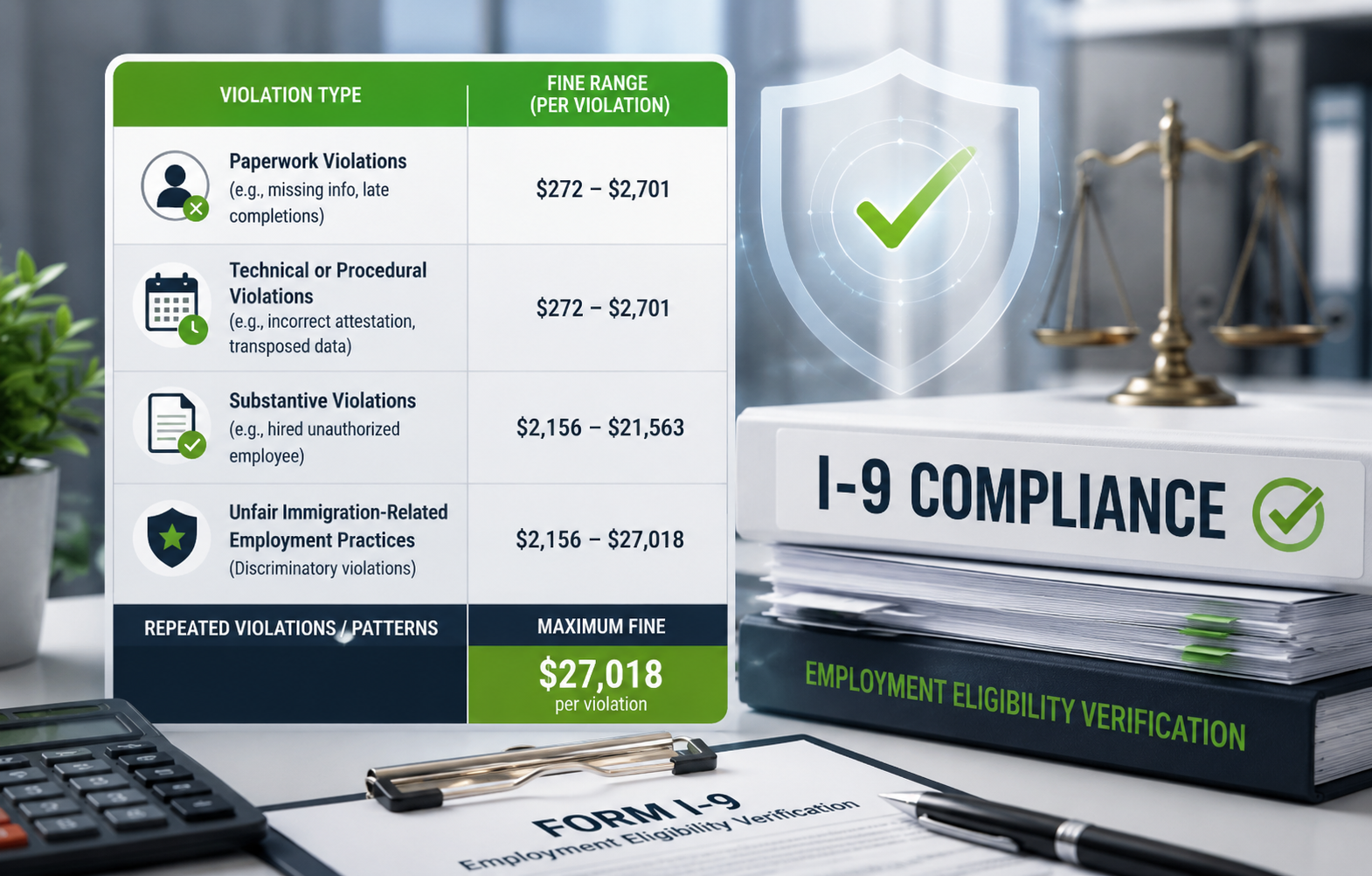
The 2024 inflation adjustment set I-9 paperwork fines at $281 to $2,789 per violation. The knowing hiring, recruiting, referral, or retention of unauthorized noncitizens carried a first offense fine of $698 to $5,579 per unauthorized noncitizen, a second offense fine of $5,579 to $13,946, and a third or more offense fine of $8,369 to $27,894 per unauthorized noncitizen.
The January 2025 update nudged those numbers slightly higher. As of January 2025, paperwork violations range from $288 to $2,861 per form, and knowingly hiring unauthorized workers carries fines from $716 to $28,619 per worker, depending on whether it is a first, second, or subsequent offense.
Those figures are per person, per form. If your business has 50 employees with I-9 errors, the math becomes alarming fast.
The Full I-9 Compliance Fines Data Table (2024 to 2025)
Understanding the exact fine tiers is the foundation of any serious compliance strategy. Use this table as your reference for I-9 compliance fines by violation category.
| Violation Type | Fine Range (2024) | Fine Range (2025) |
|---|---|---|
| Paperwork / Form Error | $281 to $2,789 per form | $288 to $2,861 per form |
| Knowing Hire (1st Offense) | $698 to $5,579 per worker | $716 to $5,724 per worker |
| Knowing Hire (2nd Offense) | $5,579 to $13,946 per worker | $5,724 to $14,308 per worker |
| Knowing Hire (3rd+ Offense) | $8,369 to $27,894 per worker | $8,586 to $28,619 per worker |
| E-Verify Failure to Report | $973 to $1,942 per employee | $998 to $1,994 per employee |
These adjustments are not random. Each year, penalties pursuant to the Immigration and Nationality Act of 1952 are adjusted for inflation, and both DHS and DOJ implement the three employment-related penalty sections, meaning both departments’ regulations reflect the updated civil penalty amounts.
That annual adjustment cycle means I-9 compliance fines will keep climbing every January. Businesses that do not track these updates risk being caught off guard when they receive a Notice of Intent to Fine.
How ICE Calculates the Exact Fine Amount
Knowing the range is only part of the picture. ICE uses a structured formula to land on a specific number within that range.
To determine the base fine amount, the number of substantive violations and uncorrected technical or procedural failures are divided by the number of Forms I-9 that should have been presented for inspection. The resulting percentage determines the minimum and maximum civil penalty base fine amount, and this percentage may change depending on whether the offense is the employer’s first, second, or third or higher offense.
Once the base amount is set, ICE applies five statutory factors to adjust it upward or downward. Those factors include the size of the business, good faith efforts toward compliance, seriousness of the violation, whether the workers involved were unauthorized, and the history of previous violations.
A small employer with a clean record making an honest paperwork error will typically face fines at the lower end. A large employer with prior audit findings and a pattern of incomplete forms will face fines near the ceiling of the I-9 compliance fines range.
This is why internal audits matter so much before ICE ever shows up.
The 7 Audit Trigger Events That Lead to I-9 Compliance Fines
Most employers assume they will simply never be audited. That assumption has become significantly more dangerous in 2025 and 2026. Here are the seven events most likely to bring ICE to your door.
1. Tips and Complaints from Individuals
Many events can trigger the I-9 audit process, such as random selection, tips, or complaints. A tip can come from a current employee, a former employee, a competitor, or anyone with knowledge of your hiring practices. ICE takes these reports seriously and uses them as a starting point for formal inspections.
2. IRS Data Discrepancies
This is one of the newest and most powerful triggers. ICE does not disclose its exact selection criteria. However, commonly cited factors include IRS data discrepancies through the new memorandum of understanding between ICE and the IRS. If the Social Security numbers your employees provided do not align with IRS tax records, that mismatch can flag your business automatically.
3. High Risk Industry Targeting
Enforcement patterns in high risk industries such as construction, food service, agriculture, and staffing are among the commonly cited audit selection factors. If your business operates in one of these sectors, your statistical likelihood of facing I-9 compliance fines through an audit is meaningfully higher than in other fields.
4. Data Analysis and Red Flags
If Homeland Security’s data analysis identifies any red flags with respect to a particular employer, or potentially even a particular industry or geographic region, this can trigger an I-9 audit as well. DHS is increasingly sophisticated in how it mines employment data to find patterns of potential noncompliance.
5. Media Attention and Public Reporting
Publicity surrounding a company’s hiring practices or immigration compliance, including news coverage linking the employer to unauthorized employment, is an additional audit trigger. If your business appears in local or national news in connection with labor or immigration issues, expect heightened scrutiny.
6. Business Changes Like Mergers or Acquisitions
Ownership transfers, mergers, or acquisitions that require review of existing I-9 records are also listed among audit triggers. When a business changes hands, the new ownership inherits the I-9 compliance history of the previous entity. Buyers who skip an I-9 audit during due diligence can inherit substantial I-9 compliance fines liability.
7. Prior Violations and Unresolved Discrepancies
A history of previous I-9 compliance issues or audit findings, including repeated errors or unresolved discrepancies from past government reviews, is a documented trigger for follow-up audits. ICE tracks prior enforcement actions. Businesses with past Notices of Intent to Fine are far more likely to be reinspected.
What Happens After ICE Issues a Notice of Inspection?
Understanding the inspection process is critical to knowing how quickly I-9 compliance fines can materialize.
The administrative inspection process begins with a Notice of Inspection (NOI), giving employers at least three business days to produce the requested Forms I-9. Three days is not much time if your records are disorganized, stored in multiple locations, or partially incomplete.
During inspections, Homeland Security Investigations may request additional documentation such as payroll records and business licenses. This means the scope of an audit goes well beyond the forms themselves.
If errors are found, the outcome depends heavily on whether the violations are classified as technical or substantive.
Technical or procedural violations give the employer a correction window. Substantive violations trigger immediate I-9 compliance fines with no opportunity to fix the error first.
More than 10 error categories previously treated as correctable technical violations, eligible for the statutory 10-day cure period, were reclassified as substantive violations subject to immediate fines of $288 to $2,861 per form through an ICE fact sheet updated in March 2026.
Substantive vs. Technical Violations: The Line That Costs You
Before March 2026, many employers relied on the assumption that minor Form I-9 errors could be corrected after an NOI arrived. That window has now been dramatically narrowed.
Substantive violations result in immediate monetary fines following inspection, with no allotted period for correction. Technical or procedural violations are minor deficiencies that an employer has 10 business days to correct before they become substantive violations.
The categories reclassified as substantive under the updated ICE guidance include missing dates in Section 1 or Section 2, failure to check the alternative procedure box when remote verification was used, and failures within electronic I-9 systems related to audit trails or electronic signatures.
ICE also signals a stronger enforcement posture toward electronic Form I-9 systems. The March 2026 fact sheet lists failure to meet regulatory requirements for electronic completion, audit trails, signatures, record security, and reproducibility as substantive violations.
This is a significant shift. Businesses using third party electronic I-9 platforms cannot assume their vendor’s compliance covers their own liability. You must verify that your system meets all DHS regulatory requirements.
DHS Form I-9 Revision Dates: A Complete Timeline
One of the most common sources of I-9 compliance fines is the use of an outdated form version. USCIS has revised Form I-9 many times since the form was first introduced in 1987.
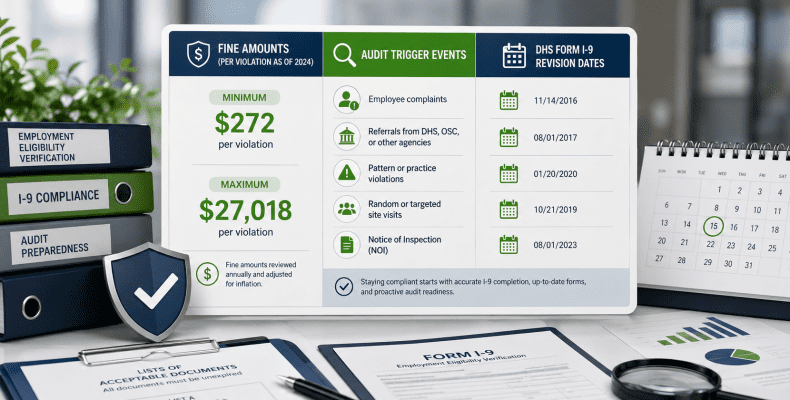
Listed below are the dates Form I-9 was revised, as documented by USCIS. The revision history includes: Rev. 08/01/2023, Rev. 10/21/2019, Rev. 07/17/2017, Rev. 11/14/2016, Rev. 03/08/13, Rev. 08/07/09, Rev. 02/02/09, Rev. 06/05/07, Rev. 03/26/07, Rev. 05/31/05, Rev. 11/21/91, Rev. 05/21/90, Rev. 05/07/87, and Rev. 03/20/87.
The most recent revision occurred in January 2025. USCIS released a revised Form I-9 dated 01/20/25 and valid through May 31, 2027. The changes reflect statutory language updates and an updated DHS Privacy Notice.
The most visible change in the 01/20/25 edition is that the Section 1, Box 4 attestation language changed from “A noncitizen authorized to work” back to “An alien authorized to work,” reverting to the statutory language used in the Immigration and Nationality Act.
Employers may also use the Form I-9 with an 08/01/23 edition date, valid until its expiration date of 05/31/2027, or the 08/01/23 edition date version valid until its expiration date of 07/31/2026.
Current acceptable editions as of June 2026:
- Edition 01/20/25, expires 05/31/2027 (current preferred edition)
- Edition 08/01/23, expires 05/31/2027
- Edition 08/01/23, expires 07/31/2026 (electronic systems only)
All other prior editions are no longer valid for new completions and should not appear on any I-9 completed today.
Using an outdated form version is a technical violation. Left uncorrected after an inspection, it becomes a substantive violation and triggers I-9 compliance fines at the full per-form rate.
The March 2026 ICE Fact Sheet: What Changed and Why It Matters
The March 2026 update deserves special attention because it happened quietly with no Federal Register notice and no public comment period.
On March 16, 2026, ICE updated its Form I-9 Inspection fact sheet, effectively superseding key provisions of the 1997 Virtue Memorandum that had governed I-9 enforcement for nearly three decades.
That 1997 guidance had given employers a framework for what was fixable and what was not. Much of that framework no longer applies.
These changes significantly increase employer exposure during Form I-9 audits by eliminating the correction period for many of the most common paperwork errors. For decades, employers were advised that certain administrative deficiencies could be corrected after ICE issued an NOI. Under ICE’s updated guidance, many of those same errors now trigger immediate liability.
For businesses with large workforces, the practical impact is severe. A 3% error rate across 500 forms could now mean 15 immediate substantive violations. At $2,861 per form, that is over $42,000 in I-9 compliance fines before any aggravating factors are applied.
The time to find and fix errors is before the NOI arrives, not after.
How to Reduce Your Exposure to I-9 Compliance Fines
Reducing your risk starts with treating I-9 compliance as an ongoing process rather than a one-time hire task.
Conduct regular internal audits. Advisors consistently recommend that clients immediately begin an internal audit of I-9 records to ensure compliance with all requirements, as this avoids the need to make changes upon a government audit and potential fines. Internal audits let you correct technical errors before they become substantive ones.
Train your HR team specifically on Form I-9. Employers who fail to properly train and supervise the preparation and maintenance of Form I-9 expose themselves to sizable risks by making common I-9 mistakes. Training should be refreshed every time a new form edition is released.
Update your form edition immediately. Any employee onboarded using a version that was not current at the time of hire has a technical violation on record. Use the 01/20/25 edition for all new hires today.
Verify your electronic I-9 system. If you rely on a vendor platform, confirm it meets all DHS standards for audit trails, electronic signatures, record security, and reproducibility. Your vendor’s compliance does not automatically become your compliance.
Respond carefully to an NOI. If ICE delivers a Notice of Inspection, contact qualified legal counsel immediately. The three-day production window is short, but the decisions made in that window can significantly affect the final I-9 compliance fines assessment.
Why Notary and Signing Professionals Need to Understand I-9 Compliance Fines
If you work as a notary, signing agent, or mobile signing professional, your clients frequently include HR departments, real estate firms, and staffing agencies. Many of these businesses need help understanding their document verification obligations.
At PAC Signing, we work with business clients across the document verification space. Understanding I-9 compliance fines and the forms behind them is part of serving those clients well.
When clients ask about document verification processes, having a working knowledge of I-9 form editions, audit timelines, and the fine structure allows you to provide genuinely useful guidance rather than guesswork.
Frequently Asked Questions About I-9 Compliance Fines
What is the maximum I-9 compliance fine an employer can receive?
The highest tier of I-9 compliance fines applies to employers on their third or subsequent offense for knowingly hiring unauthorized workers. As of January 2025, that ceiling is $28,619 per unauthorized worker. For large employers with high error rates, total penalties across all violations can reach into the millions of dollars.
How long do employers have to produce I-9 forms after an NOI?
ICE must give the employer a minimum of three days’ advanced notice after issuing a Notice of Inspection. The employer must provide copies of all requested I-9 forms and may also be asked to provide supporting documents such as payroll records and business licenses.
Can an employer correct I-9 errors after receiving an NOI?
It depends on whether the violation is technical or substantive. Technical violations still allow a 10 business day correction window. Substantive violations, including many that were previously considered correctable under the March 2026 reclassification, trigger immediate I-9 compliance fines with no correction period.
Which Form I-9 edition should employers use right now?
The current Form I-9 edition is 01/20/25, valid through 05/31/2027. USCIS published this revision with relatively minor changes compared to the major August 2023 overhaul. Two versions of the 08/01/23 edition remain acceptable for now, but the 01/20/25 edition is the preferred version for all new completions.
What industries face the highest audit risk?
Commonly cited high risk industries include construction, food service, agriculture, and staffing. Employers in these sectors should treat proactive I-9 compliance as a non-negotiable operating standard rather than an occasional administrative task.
Final Thoughts on I-9 Compliance Fines
I-9 compliance fines have never been higher, enforcement has never been more aggressive, and the rules governing what is correctable versus immediately punishable have never been tighter.
The combination of the January 2025 penalty adjustments, the tenfold increase in ICE inspection rates, and the March 2026 reclassification of dozens of previously fixable errors means that employers who have been coasting on older assumptions are now significantly exposed.
The good news is that most I-9 compliance fines are avoidable. A systematic internal audit, updated forms, trained staff, and verified electronic systems are all within reach for businesses of any size.
Do not wait for a Notice of Inspection to find out where your records stand. The cost of prevention is a fraction of the cost of a fine.